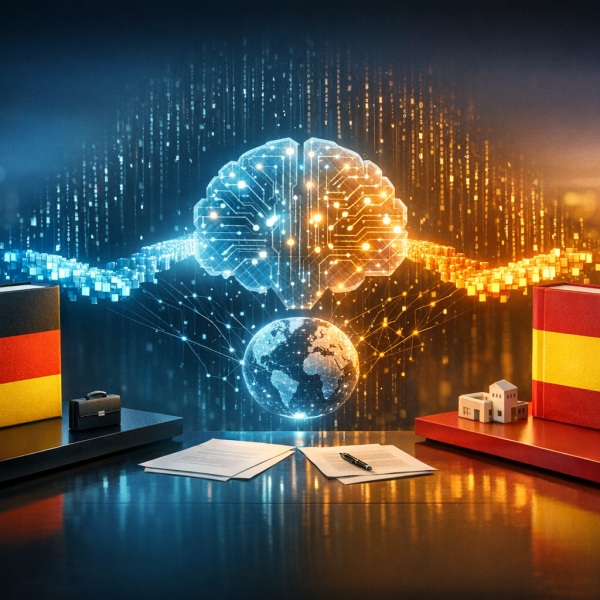
Artificial intelligence is transforming how companies handle German Spanish business communication. What was once a slow and costly process that depended entirely on human linguists is now faster, data-driven, and increasingly integrated into everyday corporate workflows. For German companies expanding into Spain or Latin America, and for Spanish-speaking brands targeting the German market, AI-powered translation tools are reshaping strategy, speed, and scale in remarkable ways.
1. From Static Translation to Dynamic German Spanish Communication
Traditional German Spanish business translation relied on static documents and one-off translation projects. AI has changed this model completely. Today, companies can maintain a continuous flow of multilingual content: emails, contracts, presentations, websites, product descriptions, and social media posts are updated and translated in near real time.
Modern AI systems learn from previous translations and adapt to company-specific vocabulary, terminology, and style preferences. This means that a German manufacturer sending product specs to a Spanish partner, or a Spanish retailer sending marketing material to German audiences, can keep information aligned, updated, and consistent across markets.
2. Faster Time-to-Market with AI-Assisted Spanish Translation
Time-to-market is critical in international business. AI drastically reduces the turnaround time for translating and localizing materials, allowing brands to launch campaigns, product instructions, financial reports, and marketing collateral on tighter schedules.
Instead of waiting days for first drafts, AI can generate preliminary German Spanish translations in seconds. Human linguists then refine these drafts, ensuring accuracy and nuance. This hybrid workflow means companies benefit from speed without sacrificing quality.
For complex projects that demand high accuracy, especially in legal, financial, technical, or medical fields, partnering with professional linguists who leverage AI tools is crucial. That is where spanish translation services come into play, blending cutting-edge technology with expert human oversight to maintain reliability and brand integrity.
3. Improved Consistency in Terminology and Branding
Consistency is one of the biggest advantages AI brings to German Spanish business translation. Large organizations often struggle to keep terminology stable across departments, subsidiaries, and external partners. AI-powered translation memories and glossaries store preferred terms, so key expressions like legal clauses, product names, technical features, and slogans are used consistently.
When companies update a product or rebrand, modern translation systems can update all related content rapidly. German headquarters can roll out new messages in Spanish markets with confidence that the tone, wording, and legal precision remain aligned with corporate guidelines.
4. Lower Costs with Smarter Translation Workflows
AI does not just make translation faster; it also makes it more cost-efficient. Automated pre-translation and machine-assisted workflows mean human translators spend less time on routine or repetitive content and more on high-impact tasks like stylistic refinement, sensitive negotiations, and complex legal or technical documents.
Companies working with large volumes of German Spanish content can significantly reduce their per-word costs over time, especially when they manage multilingual websites, e-commerce catalogs, user manuals, and customer support materials. Savings can be reinvested in content quality, SEO localization, and broader market coverage.
5. Enhanced SEO for German and Spanish Markets
AI is a powerful ally in multilingual SEO. For brands operating between Germany, Spain, and Spanish-speaking Latin America, ranking well in local search engines is essential for visibility and lead generation. AI tools can help identify keyword equivalences, user intent, and search trends across languages.
For instance, a direct German-to-Spanish translation of a keyword might not match what Spanish users actually type into search engines. AI systems, combined with SEO expertise, analyze real search behavior and suggest better keyword choices. This way, landing pages, blog posts, and product descriptions are optimized not only linguistically but also strategically for both markets.
AI also speeds up A/B testing in multiple languages. German companies can test Spanish versions of headlines, calls-to-action, and product names, gather performance data, and iterate quickly. This cycle of testing and optimization is far more efficient with AI-assisted workflows.
6. Better Customer Experience in Cross-Border Communication
Customer experience is increasingly multilingual. German and Spanish-speaking clients expect clear, accurate information in their language of choice across all touchpoints: websites, apps, emails, chat, support portals, and social media. AI helps companies provide this experience at scale.
Machine assistance has changed the economics of routine language work while leaving the difficult judgement calls exactly where they were. The same redistribution is happening in web design and development, where scaffolding is increasingly automated and architecture is not. Tools move the labour; they rarely move the responsibility.
Automation has changed drafting speed without changing what authorities require at the end of the process. The bottleneck simply moved. Applicants still have to understand what is an apostille and when a document needs one, since no tool decides that for them.
Chatbots and virtual assistants can now handle basic customer queries in both German and Spanish, offering instant responses around the clock. Support articles, FAQs, and knowledge bases can be translated and updated quickly, reducing friction for international users. When combined with human agents, AI-driven tools ensure customers receive timely assistance in their native language, improving satisfaction and loyalty.
7. New Collaboration Models between Humans and AI
AI has not replaced human translators; it has redefined their role. In German Spanish business translation, professionals increasingly act as editors, consultants, and quality controllers. They train AI systems with domain-specific data, curate terminology, and make strategic decisions about tone, style, and cultural adaptation.
This collaboration allows companies to tackle larger, more complex multilingual projects than ever before. Legal teams coordinate bilingual contracts, marketing teams run integrated campaigns, and technical departments manage bilingual documentation without losing control over quality or nuance. The human-in-the-loop model ensures that AI-driven efficiency is balanced by human judgment and responsibility.
8. Handling Cultural Nuance and Regional Variants
German Spanish translation is not just about language pairs; it is also about cultural and regional variation. Spanish differs significantly between Spain, Mexico, Argentina, Colombia, and other countries. AI increasingly recognizes these differences, offering region-specific options and suggesting alternative phrasing for local markets.
However, cultural adaptation still requires expert human insight. Humor, idioms, legal references, and industry jargon can be sensitive. Smart companies rely on AI for scale and speed but always involve qualified linguists to ensure that messages fit local expectations and regulations, whether a German firm is targeting Madrid, Mexico City, or Buenos Aires.
Conclusion: AI as a Strategic Asset in German Spanish Business Translation
AI has become a strategic asset for any organization operating between German and Spanish-speaking markets. It accelerates translation, reduces costs, improves consistency, and enhances SEO performance. It also makes continuous multilingual communication possible, supporting integrated marketing, sales, and customer service strategies.
Yet, the real power of AI emerges when it is combined with human expertise. Professional linguists, domain specialists, and localization managers ensure that translations are not only fast but also accurate, compliant, and culturally appropriate. Companies that embrace this hybrid approach will be better positioned to build trust, win clients, and grow sustainably across German and Spanish-speaking regions.
As AI technologies continue to evolve, businesses that invest in intelligent translation workflows today will have a decisive advantage tomorrow, turning language from a barrier into a competitive edge in international markets.